

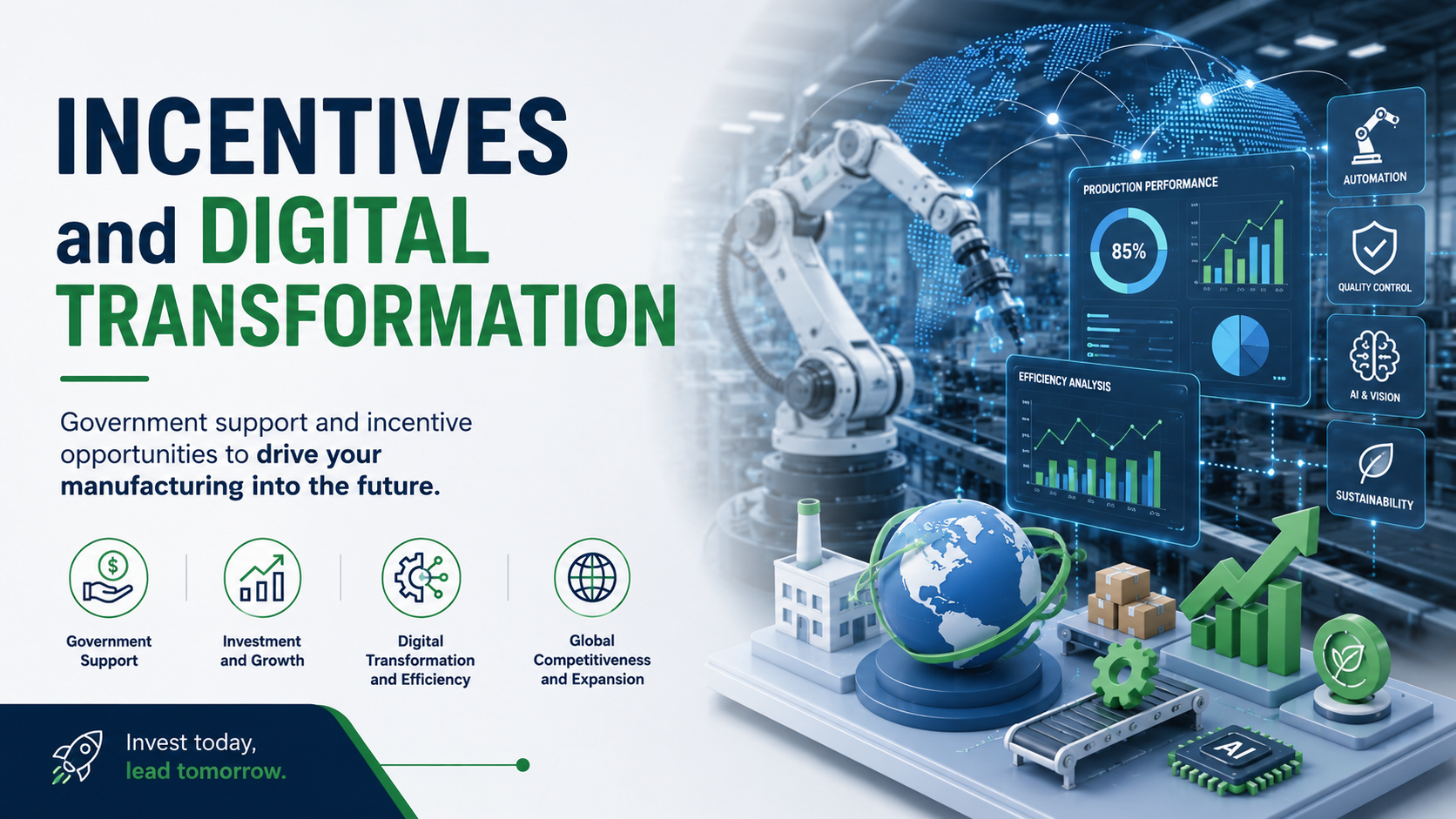
In the manufacturing sector, competitiveness is no longer about simply producing more; it is about producing more efficiently, with higher quality, and using more advanced technologies.
Artificial intelligence, computer vision, automation, data analytics, and smart quality control systems are playing an increasingly important role in the transformation of manufacturing processes. However, the cost of these technological investments can be one of the biggest barriers for many manufacturing companies when making digital transformation decisions.
For companies manufacturing in Türkiye, various R&D, investment, digital transformation, green transformation, export, and branding incentives offered by different institutions present significant opportunities.
So, which incentives are available to manufacturing companies, and where can projects such as AI-powered quality control be positioned within these support mechanisms?

1. TÜBİTAK Industrial R&D Support Programs
For manufacturing companies developing new technologies, significantly improving existing processes, or developing innovative products or processes, TÜBİTAK TEYDEB support programs are among the key options.
In particular, the TÜBİTAK 1501 Industrial R&D Projects Support Program supports R&D, technology development, and innovation activities carried out on a project basis by SMEs. In the second call of 2026, the support rate was set at 75% for the first five supported projects and 60% for subsequent projects, with TÜBİTAK’s contribution capped at TRY 20 million per project.
For manufacturing companies, potential project areas may include:
- AI-based quality control,
- Defect detection through computer vision,
- Next-generation production control systems,
- Automated measurement and classification,
- Production data analysis,
- Development of new manufacturing processes.
TÜBİTAK 1507: A Starting Point for SME R&D
For SMEs that are new to R&D activities, the TÜBİTAK 1507 SME R&D Startup Support Program is another important alternative.
The program aims to support SMEs’ project-based research, technology development, and innovation activities. The second call for 2026 was launched on July 20.
Therefore, R&D support programs should also be considered for manufacturing companies that are planning to introduce technologies such as artificial intelligence and computer vision into their production processes for the first time.
2. KOSGEB Support Programs: Capacity and Digitalization-Focused Investments
For manufacturing companies with SME status, KOSGEB support programs can also provide an important financing alternative.
In particular, the Capacity Development Support Program aims to strengthen businesses in areas such as productivity, production capacity, market size, resilience, and organizational structure. The program also focuses on developing SMEs that are part of the supply chains of larger companies.
In manufacturing facilities:
Capacity Increase → Automation → Digitalization → Quality Control → Data Analytics
should not necessarily be viewed as separate investments, but rather as interconnected components of the same transformation process.
Therefore, it is important for manufacturing companies to consider not only machinery investments but also digital systems that make production processes more measurable and controllable as part of their overall transformation strategy.
3. Investment Incentive System
For companies planning to establish a new manufacturing facility, increase the capacity of an existing facility, or make technology-intensive investments, the Investment Incentive System is one of the most important areas to consider.
Depending on the nature of the investment and its location, the current system may provide various forms of support, including:
- VAT exemption,
- Customs duty exemption,
- Tax reduction,
- Interest or profit-share support,
- Allocation of investment land,
- Employer’s social security premium support in certain cases.
Especially for new production lines, high-tech investments, and capacity expansion projects, considering incentive mechanisms at the very beginning of investment planning can significantly affect the company’s overall investment cost.
4. Artificial Intelligence and Technology-Focused Support Programs
Artificial intelligence is no longer only on the agenda of technology companies.
In manufacturing facilities, the combination of:
Camera + Computer Vision + Artificial Intelligence + Data Analytics
creates an important area of transformation in terms of quality control and operational efficiency.
Among TÜBİTAK’s current national support programs are initiatives such as 1711 Artificial Intelligence Ecosystem Call, 1832 Green Transformation in Industry, 1831 Green Innovation Technology Mentoring, and 1707 Order-Based R&D Projects.
This structure allows manufacturing companies to focus not only on conventional R&D projects but also on more specific transformation areas such as artificial intelligence, sustainability, and technology transfer.
5. Green Transformation and Sustainable Manufacturing Support
Digitalization and sustainability in manufacturing are increasingly being considered together.
Digitally monitoring manufacturing processes can contribute to:
- Reducing scrap rates,
- Detecting defective production at an early stage,
- Preventing unnecessary production,
- Monitoring energy and resource consumption,
- Improving process efficiency.
The TÜBİTAK 1832 Green Transformation in Industry program and other green transformation-focused support mechanisms are among the important programs supporting sustainable and technology-driven transformation in industry.
Therefore, quality control investments can be approached not only as a means of “detecting defective products,” but also as a transformation project that improves resource utilization and production efficiency.
6. TURQUALITY and Export-Oriented Support
For manufacturing companies aiming to expand in global markets, another important dimension of incentives is export and branding support.
Within the framework of the Ministry of Trade’s Brand and TURQUALITY support programs, various support mechanisms are available for areas such as promotion, brand registration, consultancy, target-market activities, and international operations.
The key point here is:
For a manufacturer aiming to go global, production quality is just as much a part of the brand as sales and marketing.
Meeting the quality standards of customers in different countries, ensuring production continuity, and making quality data measurable can directly improve the competitiveness of export-oriented companies.
7- Ministry of Trade – Global Supply Chain (GSC) Support
The Global Supply Chain (GSC) Competency Project Support aims to help manufacturing companies join the supply chains of global companies, strengthen their existing supplier capabilities, and increase their export capacity. The support is particularly relevant for manufacturers operating in sectors such as automotive, home appliances, machinery, and electronics. According to the Ministry of Trade’s current information, the GSC Support is active and open for applications on an ongoing basis.
To benefit from the support, the company must be a manufacturing company that has been exporting for at least one year prior to the application date. The main objective of the program is to help companies develop the technology, production capacity, quality, efficiency, design, and sustainability capabilities required to participate in global supply chains and become suppliers to international companies.
For manufacturing companies, projects involving areas such as:
- Development of production capacity and technological infrastructure,
- Investments in new machinery and equipment,
- Improvement of quality and production processes,
- Automation and digital transformation applications,
- AI- and computer vision-based quality control systems,
- Becoming a supplier to global automotive, home appliance, or machinery manufacturers,
- Supplying new products to an existing global customer,
- Increasing efficiency and sustainability across production processes,
may be evaluated within the scope of the project, provided that they align with the company’s objective of entering or strengthening its position within global supply chains.
From MonitEye’s perspective, it is important to note that the GSC Support is not directly an “R&D support for developing AI software.” Rather, it is designed to support the capabilities and investments required by manufacturing companies to enter global supply chains and strengthen their competitiveness as suppliers.
Therefore, a technology solution such as MonitEye can be positioned as part of a manufacturer’s quality control, production efficiency, or digital transformation project—for example, within an automotive supplier’s initiative to improve its production capabilities and meet the technological and quality requirements of global customers.
Where Does MonitEye Fit into This Transformation?
One of the most important steps for manufacturing companies seeking to benefit from incentives is to define the planned investment as a measurable, project-based transformation objective.
This is where MonitEye comes into play.
MonitEye helps digitalize quality control processes by analyzing images obtained from existing camera infrastructure on production lines using artificial intelligence and computer vision technologies.
For example, in a manufacturing facility:
– Automated Defect Detection
Automatically detecting predefined quality issues on products through camera images.
– Measurement and Compliance Control
Checking parts, products, or joining points against predefined dimensions and tolerances.
– Digitalization of Quality Data
Recording inspection results and generating reports to make production performance traceable and measurable.
– Process Efficiency
Analyzing at which stage quality problems occur and how frequently they arise.
– Continuously Improving Quality Control with AI
Training models using defective and defect-free product samples to improve automated quality control processes.
These activities can be evaluated together with a company’s digital transformation, R&D, artificial intelligence, quality, and production efficiency objectives.
Important: Whether a technology qualifies for an incentive depends not solely on the technology being used, but on factors such as the company’s size, project scope, nature of the investment, sector, specific call requirements, and applicable legislation. Therefore, using MonitEye does not automatically create eligibility for any incentive; the appropriate support program and project structure should be evaluated separately.
In Manufacturing, the Key Is Not to Wait for Incentives — It Is to Plan the Transformation
In today’s manufacturing sector, it is no longer sufficient to view technology investments simply as a decision to purchase a machine or software.
The right approach should be:
Identify the need → Build the transformation project → Research suitable incentives → Position the technology → Measure the results
In particular, investments in artificial intelligence, computer vision, automation, and data analytics can not only improve quality but also make manufacturing processes more measurable, traceable, and sustainable.
The various support mechanisms offered by TÜBİTAK, KOSGEB, the Ministry of Industry and Technology, and the Ministry of Trade in Türkiye provide important opportunities for manufacturing companies to carry out this transformation in a more structured and strategic way.
At MonitEye, we help manufacturing companies digitalize their quality control processes with artificial intelligence and computer vision technologies, enabling more measurable, faster, and more controlled production processes.
Discover which processes on your production line can be digitalized with artificial intelligence.
Rethink quality control with MonitEye and the manufacturing technologies of the future.